
OUJING KINDERGARTEN
English education
English is a means of genuine communication, connected with everyday life.
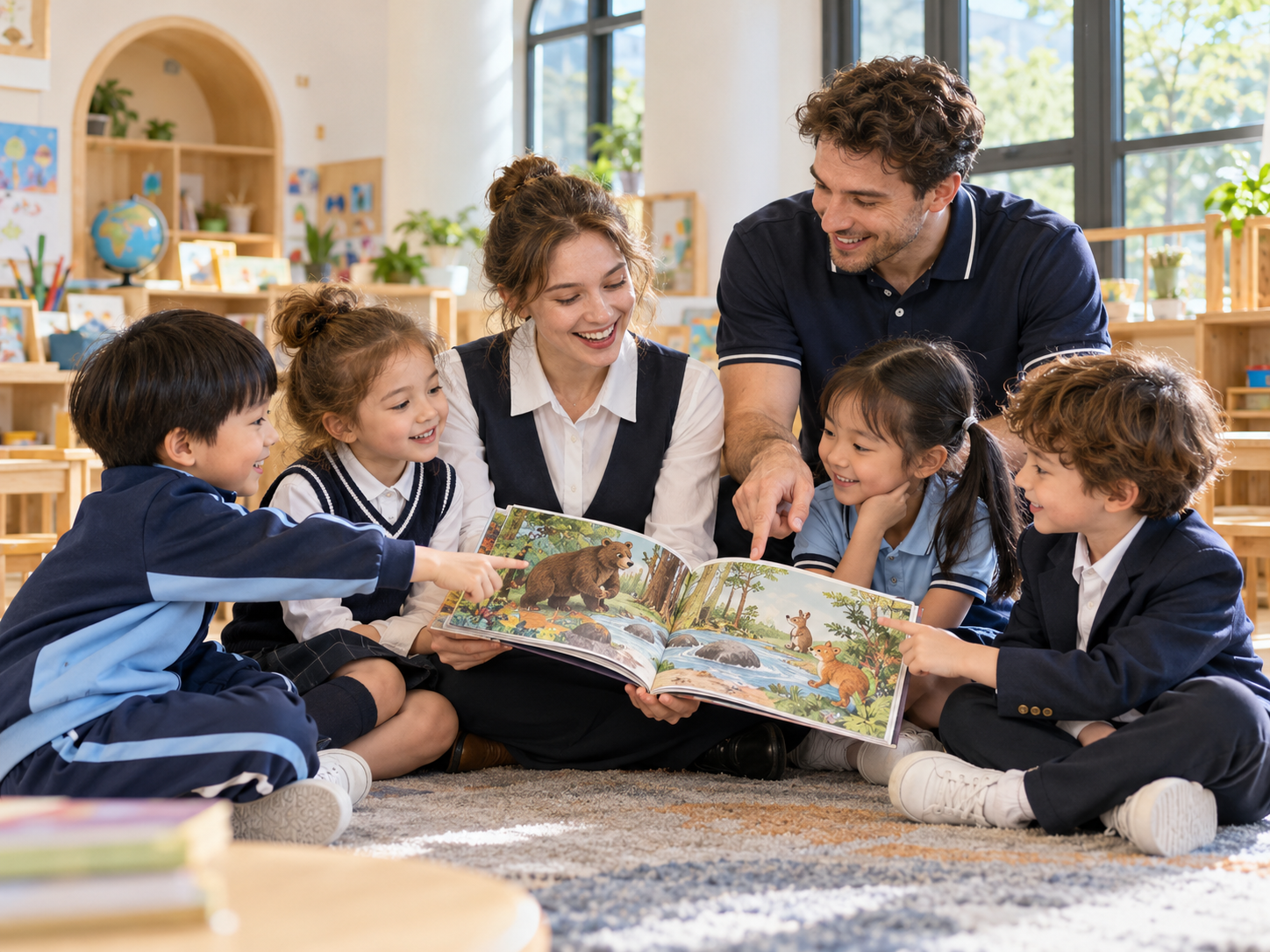
Understanding through life, growing through conversation
We want children’s English experiences to draw on natural language learning. They can understand invitations during play, ask questions in inquiry, express everyday needs and gradually understand more through interaction.
When English becomes part of life, understanding and expression can develop with experience.
Teachers and children talk around the table during a meal.
Dual Foreign Teacher 2.0: shared, direct teaching
Each participating class has two international teachers and one Chinese co-teacher with fluent English listening and speaking skills during English weeks.
Both international teachers teach and interact directly with children, and all three teachers use English as their sole working language.
An introduction to Oujing’s English approach, from teacher collaboration and age-appropriate development to the transition to primary school.
Video transcript
Why does Oujing place two foreign English teachers in one class? What does the second teacher change? To understand the system, we need to connect how teachers work together, how children use English, and how learning develops from ages three to six.
Consider an everyday situation. A child often starts in Chinese with a Chinese teacher who has always spoken Chinese with them. With a foreign teacher who consistently interacts in English, a different expectation gradually develops: playing together or asking this teacher for help involves English. Children draw on the person in front of them and their previous exchanges to decide how to communicate.
We also use a foreign teacher's recognizable face as a cue for English activities. Faces, voices, settings and past language experiences together suggest how people communicate here. Consistent English interaction then helps children expect to use English with this teacher. A face helps them recognize the person; how adults repeatedly speak and respond makes that expectation more stable.
Why design this environment? Oujing wants children to have chances to understand and respond directly in English. Adults help when needed, without always translating first or answering for the child. Staffing and adult communication make English useful within an activity: organizing it, making requests and responding. Objects, actions and demonstrations support understanding, while children have time to join in through a look, an action, a word or a short phrase.
Oujing's Dual Foreign Teacher 2.0 model places two foreign English teachers in one class, alongside a Chinese teacher who co-teaches English. Both foreign teachers take part in that class's activities. What can this collaboration do? A block-building example illustrates three ways it can work.
First, English can move beyond one person's way of speaking and become communication between people. If a foreign teacher speaks English to children while surrounding adults mainly speak Chinese to one another, children may still see English as belonging only to that teacher's lesson. With both teachers taking part, adult-to-adult exchanges in English become possible. One might ask the other for a red block; the other confirms, passes it over, and they keep building. Children see English used to request, respond and work together.
Second, the activity and children's participation can receive more individual support. One teacher might lead the building while the other approaches a child who has not yet joined in, helps with gestures, objects and simpler language, then invites the child to pass a block. English interaction can continue while the child has a way to participate.
Third, children communicate with different people. When someone else asks the same thing, or the setting changes, can the child still understand? Different teachers' voices and expressions can reduce dependence on one teacher or one fixed question. To assess the two-teacher model, look at whether both teachers actually communicate and whether children participate. Simply counting the adults in the room is not enough.
What does the Chinese co-teacher of English do? Consistent English communication can make this teacher part of the same environment. Simpler English, objects and gestures help children understand; the teacher then returns the chance to respond to the child and reconnects them with the foreign teachers' activity. The co-teacher also helps organize and observes participation, rather than routinely translating every sentence or answering for children. Again, a face is only one cue. Ongoing communication and collaboration stabilize language expectations.
This environment should support growth throughout the three years from ages three to six. Play, picture books and daily life are already ways young children understand the world and express their needs. Oujing emphasizes this stage so English can remain part of familiar activities, gradually building understanding, participation, and listening and speaking habits.
Our view is to emphasize early English in kindergarten, Chinese language foundations in primary school, and mathematical thinking in secondary school. This is Oujing's approach to learning priorities at different stages. In kindergarten, the environment must also connect with progression through the younger, middle and older groups.
Return to the block-building example. The younger kindergarten group focuses on listening. The teacher asks in English for a red block, using pointing and demonstration. Finding and passing it offers a clue to understanding. Prompts are then gradually reduced to see whether understanding remains. We look for a connection between the sounds children hear, the objects they see and what they are doing.
The middle kindergarten group keeps listening and has more chances to speak. Asked which block they want and where it should go, children can move from a word to a short response. The teacher acknowledges their expression, passes the block and keeps building with them. Children gradually experience how their response keeps communication going and expresses a choice.
The older kindergarten group increasingly focuses on initiating expression. As understanding and expression develop, teachers gradually reduce prompts and leave choices, requests and explanations to children. To join the building, children can try asking; if a piece is missing, they can seek help; when sharing their creation, they can explain their ideas. They gradually move from following an activity to starting an exchange themselves.
Younger children who want to speak are always encouraged; older children keep listening and interacting. Listening in the younger group, listening plus speaking in the middle group, and more self-initiated expression in the older group describe curriculum priorities. Understanding, responding and expression support one another throughout. Children are not expected to stay silent for two years and suddenly start speaking in the older group.
Parents should not judge progress only by the length of a speech or the number of words memorized. Recitation and presentations can be practice. Also look at whether children understand and respond to a different person or a different question, and whether they can use learned expressions in an appropriate situation.
Parents need not rush children into complete sentences, but patience should be informed. If a child speaks little for now, observe what they understand and how they participate. If little changes over time, work with the teacher to check whether the language is understandable, interaction opportunities are sufficient, and support needs adjusting. A continuing lack of response cannot always be explained as language still accumulating.
Oujing has a clear kindergarten development goal. By graduation at around age six, the aim is everyday English listening and speaking comparable to that of native English-speaking children aged four to five. This goal concerns listening comprehension and spoken communication. For each child, we look at understanding, responses and actual use.
The pathway continues after kindergarten. For its own graduates during primary school, Oujing offers free weekend English classes with foreign teachers. These consolidate listening and speaking, then strengthen vocabulary, grammar, reading and writing in groups based on actual ability. This connects the listening and speaking built in kindergarten with more systematic learning in primary school.
This creates a continuing learning cycle: a stable environment provides input, objects and interaction support understanding, and real needs lead to responses and expression. Different people, activities and later primary-school learning then provide repeated use and continued consolidation.
Return to our opening question. Two foreign teachers in one class are intended to change the conditions for communication: adults work together in English, children receive support to participate, and they can interact with different people. The Chinese co-teacher, the three-year curriculum and primary-school continuation connect these conditions into a learning pathway. Ultimately, when real needs arise, we want children to progress from understanding and responding to initiating expression in English. This is the shared direction of Oujing's English system.
Two foreign teachers in a kindergarten middle group
Watch children in the kindergarten’s middle group interact with teachers through colour games and hands-on activities.
A language environment beyond individual lessons
Greetings, play, picture books, movement, art and inquiry can all offer meaningful language contexts. Repeated encounters during familiar activities resemble everyday communication more closely than mechanical memorization alone.
We value understanding, natural conversation and willingness to speak, with vocabulary recitation as only one possible indicator.
Chinese and English teaching support one another
English and Chinese learning can work together. Both should connect around shared themes and development goals, building on children’s existing experience.
For example, after exploring seasons in Chinese, children might continue through observation, outdoor activities, books and English conversation. This illustrates collaboration, rather than recording an actual lesson.
Seeing language development over time
Oujing Kindergarten carries out one-to-one English interaction assessments each term, with six international teachers taking part. Through English-only interaction, teachers observe children’s listening comprehension, responses, spontaneous expression and communication in real situations.
Full recordings support comparison across stages. Children’s audio and video records are used only within authorized educational and family communication purposes; website publicity does not automatically authorize publication.
Sharing thoughts about a toy in hand.
Positive language experiences for the future
We want children to understand English, want to use it and feel confident communicating. Positive early experience can support continued learning, without guaranteeing future academic results for every child.
FURTHER READING
You may also be interested in
Choose a topic to explore further.
Questions about English education
Why focus on English in kindergarten if my child may never study abroad?
English is an important part of education from primary school to university in China, alongside international communication.
Oujing emphasizes early listening comprehension, spoken expression and confidence to support education in China and lifelong learning, rather than preparing every child for overseas study.
Is earlier always better when learning English?
Young children enjoy imitation, play and natural conversation, making this a valuable time for age-appropriate English experiences.
Oujing emphasizes everyday life, play and inquiry, rather than early memorization of large word lists or complex grammar.
The language environment, teaching approach and continuity matter alongside the starting age.
Can good kindergarten English make later entrance examinations easier?
A strong English foundation may reduce later difficulties with listening, speaking and basic comprehension.
Children who need less time catching up on basic English may have more energy for mathematics, physics, chemistry and other subjects.
Oujing hopes English can become a strength rather than a subject requiring repeated remedial work over many years.
Why are short courses alone unlikely to build listening and speaking?
Listening and speaking involve quickly understanding connected speech, recognizing meaning and responding in real conversation, alongside vocabulary and grammar.
These skills usually need sustained exposure and repeated practice.
Oujing therefore emphasizes real listening and speaking experience from early childhood, beyond short-term memorization.
Does English education reform in China place more emphasis on listening and speaking?
China’s 2022 compulsory education English curriculum standard emphasizes language ability, cultural awareness, thinking and learning skills, and language use in authentic contexts.
Listening and speaking also carry significant weight in entrance assessments in some regions.
Oujing’s aim is for children to understand, speak and communicate, building a foundation for later English study.
How does Oujing’s immersive approach differ from ordinary English lessons?
Ordinary English courses usually have fixed lesson times.
Participating age groups alternate whole English and Chinese weeks, integrating English into play, inquiry, routines and conversations during English weeks.
Oujing hopes English will become a language for real situations, beyond its place on the timetable.
Will learning English at kindergarten affect my child’s Chinese?
Normal, age-appropriate bilingual exposure does not necessarily hinder Chinese development.
Oujing coordinates English and Chinese weeks, valuing Chinese expression, reading interest and overall development alongside English listening and speaking.
English education aims to add a language ability while supporting Chinese development.
What if my child cannot understand an international teacher?
Teachers use objects, gestures, demonstrations, pictures, context and adjusted language to support understanding.
We encourage children to understand English directly over time, rather than wait for every sentence to be translated.
Children’s safety, emotions and actual understanding remain priorities.
Is Chinese completely forbidden during English weeks?
No.
English is the main teaching and communication language during English weeks, but the aim is not to prohibit Chinese.
We encourage English while respecting each child’s stage of development. Teachers use the most effective communication for safety, emotional needs and essential care.
Why avoid translating every English sentence immediately into Chinese?
Oujing wants children to connect English sounds directly with objects, actions and meaning through real situations.
Immediate translation after every sentence may lead children to wait for Chinese explanations.
Teachers therefore first use actions, objects and demonstrations, gradually developing natural listening and responses.
Do songs and memorized stories prove that a child’s English is strong?
Songs, stories and performances can build interest, familiarity with sounds and a range of expressions.
Real ability also involves understanding unrehearsed questions, expressing needs spontaneously and communicating in everyday life.
Oujing places particular value on actual listening comprehension and spoken use.
What does Oujing’s Dual Foreign Teacher 2.0 model mean?
Each participating class has two international teachers and one Chinese co-teacher with fluent English listening and speaking skills during English weeks.
Both international teachers teach and interact directly with children, and all three teachers use English as their sole working language.
The model aims to create a continuous, authentic English environment, beyond simply adding staff.
Does “two international teachers” mean there are only two in the whole kindergarten?
No.
“Two international teachers” means that each participating class has two international teachers teaching during its English week.
It does not mean there are only two in the kindergarten, or that two teachers take turns giving English lessons to every class.
Why use two international teachers and one Chinese English-speaking co-teacher, rather than one international teacher and two Chinese teachers?
Oujing pays attention to the language teachers use with one another.
With two international teachers and one fluent Chinese English-speaking co-teacher, all three can communicate in English.
This arrangement helps reduce natural switches to Chinese, offering a more continuous English environment during lessons, play and everyday teacher conversations.
What is the three-way English communication model in Dual Foreign Teacher 2.0?
During English weeks, English is the main language in all three teacher-to-teacher relationships:
International teacher A and international teacher B communicate in English.
International teacher A and the Chinese English-speaking co-teacher communicate in English.
International teacher B and the Chinese co-teacher communicate in English.
English therefore features in genuine working conversations between adults as well as teaching directed at children.
Does one international teacher teach while the other manages behaviour?
No.
Dual Foreign Teacher 2.0 requires both international teachers to teach and interact directly with children.
They may co-teach, work in small groups, provide individual support and interact in other ways, without permanently assigning one to instruction and the other to behaviour management.
Oujing hopes this creates more opportunities for children to use English themselves.
What does the Chinese English-speaking co-teacher do during English weeks?
The Chinese co-teacher has fluent English listening and speaking skills and collaborates with both international teachers to organize activities and discuss children’s needs in English.
She also provides education and care, helping the team understand children’s development.
The role is an integral part of the English teaching team, beyond Chinese translation or behaviour support.
Why alternate whole weeks of English and Chinese?
Oujing aims to keep the main communication language relatively stable for sustained periods, allowing children to understand and use English repeatedly across activities.
English weeks are taught by two international teachers and one Chinese English-speaking co-teacher; Chinese weeks are taught by the Chinese teaching team.
Both teams collaborate towards shared child development goals, integrating language education with the complete kindergarten curriculum.
How does Oujing assess children’s English?
Each term, six international teachers take part in one-to-one English interaction assessments.
English-only interaction reveals listening comprehension, responses, spontaneous expression and genuine communication.
Complete audio and video recordings support comparison of development across stages.
Are these assessments examinations and rankings for young children?
Assessment aims to understand language development and help teachers continually improve teaching.
We value understanding, willingness to speak and real language use beyond memorization or a single score.
Why keep assessment recordings from each term?
Full recordings preserve children’s actual listening and speaking at that time.
Comparing different terms helps teachers observe progress from understanding instructions and answering questions to spontaneous expression.
Ongoing recordings also help teachers understand individual patterns of language development.
Does reluctance to speak English mean a child has weak English?
Not necessarily.
Some children understand English but need more time to develop confidence in speaking spontaneously.
Teachers combine everyday interaction and one-to-one assessment to observe understanding, willingness and communication, then provide appropriate support.
What level of English do Oujing children aim to reach by kindergarten graduation?
Oujing’s English educational goal is: For children graduating at around six to have listening comprehension and natural spoken communication comparable to children aged four to five in countries where English is a first language.
The school reports that its existing internal assessment results broadly align with this goal.
We focus on real understanding, natural questions and answers, spontaneous expression and communication.
Can graduates’ listening and speaking compare with some secondary-school students?
Conversational listening and speaking do not correspond directly to school year or examination results.
In Oujing’s teaching observations, some graduates have shown everyday comprehension, responsiveness and spontaneous expression comparable to some lower or even upper secondary students.
Oujing focuses on natural listening and conversation, then continues vocabulary, grammar, reading and writing during primary school.
Can Oujing graduates continue learning English free of charge?
Yes.
Oujing Kindergarten, Yiwu offers its graduates free weekend English classes with international teachers during primary school.
Refreshments and drinks are provided, helping children maintain communication habits, consolidate listening and speaking and gradually develop reading and writing.
What do the free primary-school English classes cover?
The free primary-school classes strengthen listening and speaking while focusing on vocabulary, spelling, grammar, reading comprehension and writing.
They connect with Chinese primary-school English requirements, developing a kindergarten language foundation into more complete learning skills.
Can Oujing graduates study Grade 3 English while in Grade 1 of primary school in China?
In Oujing’s existing teaching experience, its graduates in Grade 1 of primary school can usually study English at a Grade 3 level in the Chinese primary-school curriculum.
Some with stronger English can study Grade 6-level material in the Chinese primary-school curriculum when regrouped at the beginning of Grade 2.
Oujing groups children according to actual English ability, rather than school year alone.
Why does Oujing offer free continuing English education?
Oujing regards English as an ability that needs long-term use and continued development.
The listening and speaking foundation built in kindergarten should be maintained and developed in primary school.
Free weekend classes with international teachers allow English education to continue beyond kindergarten graduation.
What should families in Yiwu look for when choosing a kindergarten for English?
Families can observe everyday English, direct teacher interaction, natural staff conversations and children’s ability to understand and express themselves without rehearsal.
Ask about ongoing assessment and learning support after graduation too.
Oujing connects Dual Foreign Teacher 2.0, whole English weeks, termly interaction assessments and free continuing primary-school English education.
What distinguishes Oujing’s English education?
Oujing emphasizes six connected features:
- Dual Foreign Teacher 2.0 in each participating class: two international teachers and one Chinese English-speaking co-teacher lead activities during English weeks.
- Three-way English communication: English is the main working language between all three teachers.
- Whole-week English immersion: alternating English and Chinese weeks bring English into daily life, play and inquiry.
- Listening and speaking first: real comprehension, natural speech and spontaneous communication matter.
- Continued observation of progress: termly one-to-one English interaction assessments retain complete recordings.
- Free learning beyond graduation: free weekend English classes with international teachers help Oujing graduates consolidate listening and speaking and develop reading and writing during primary school.
Oujing hopes English will develop from a kindergarten subject into an ability children continue using and building upon.